

The Last Free Man in Athens — Diogenes The Cynic
Diogenes of Sinope was the embodiment of Cynicism. He lived without possessions or pride, rejected wealth, manners, and even walls. Athens called him mad. He called it freedom
Compared to the likes of Aristotle and Plato, Diogenes of Sinope (404-323 BCE) was one of the lesser-known Greek philosophers. Yet he was, without question, one of the most outrageous figures in Ancient Greece.
History remembers Aristotle for his logic and Plato for his ideals—but Diogenes? He’s remembered for telling civilization to go to hell.
“It is the privilege of the gods to want nothing, and of godlike men to want little.” -Diogenes of Sinope
Archival records on the philosopher are scarce, if not entirely nonexistent, yet his ideas were so profound that they’ve secured him a place in the history books.
Diogenes was unique among his fellow Grecian philosophers. He chose to reject societal norms like “manners” and ignored the opinions of others, meanwhile advocating for complete truthfulness, always and under all circumstances. For Diogenes, this was the secret to freedom.
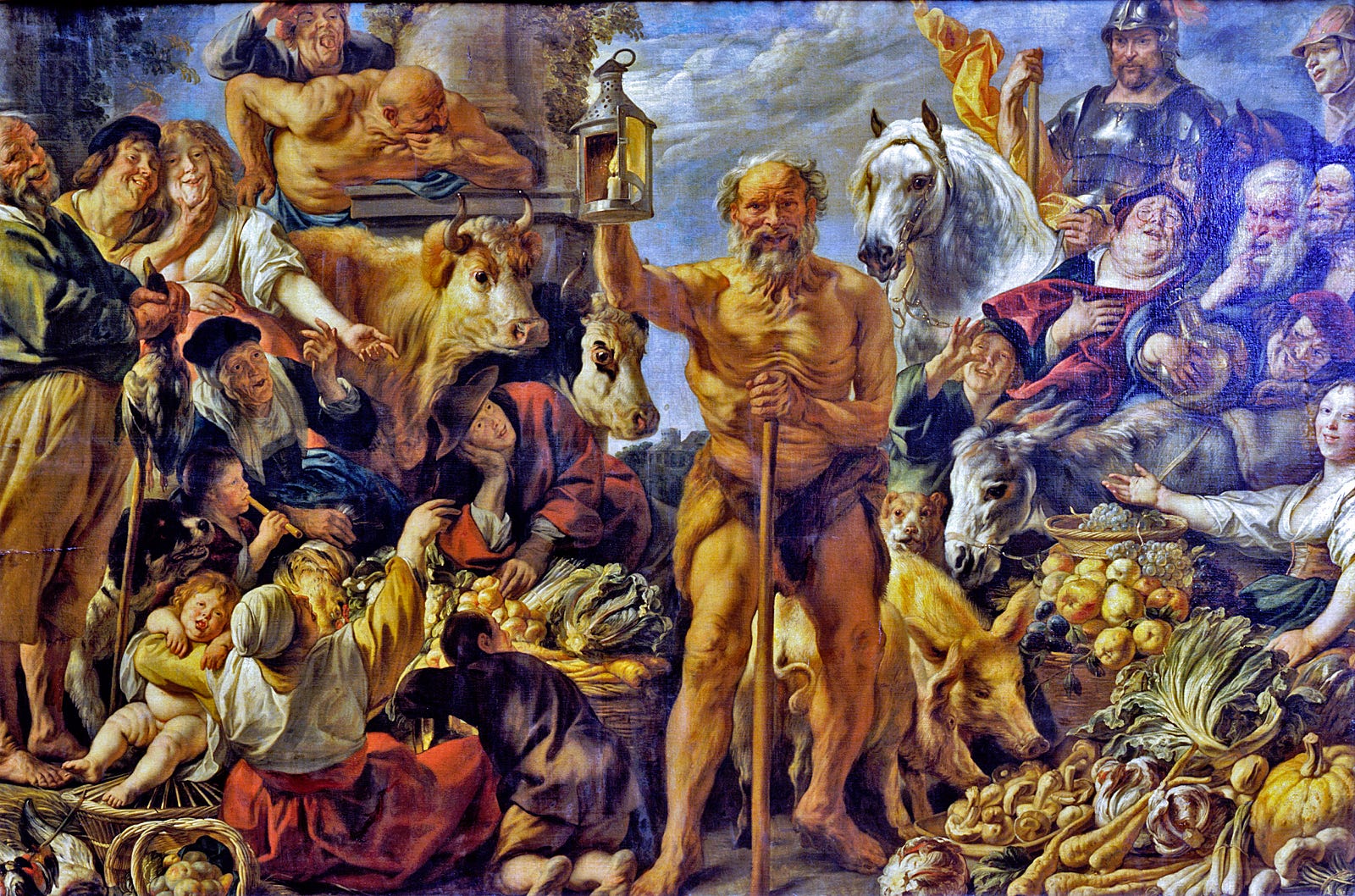
“Diogenes Searching for an Honest Man,” by Jacob Jordaens, 1642 A.D
At one point in his life, his father, who was a minter of coins in the city, was accused of defacing currency and sentenced to exile, for which Diogenes followed his father to Athens.
Diogenes began his career as a student of the similarly eccentric philosopher Antisthenes (445-365 BCE), a former student of Socrates. It has been alleged that Plato referred to him as “A Socrates gone mad.”
Born into a wealthy family, Antisthenes’ philosophy was influenced by the contradictions and injustices he observed within society. Diogenes quickly took to these lessons and applied them to his own ideology.
A Search For An Honest Man
Although originally from Sinope, the majority of Diogenes' history has been recorded in Athens. In order to follow his own philosophy, Diogenes chose to be homeless, at least in the traditional sense. For him, “home sweet home” was a ceramic tub or pithos. His house truly gave a new meaning to the phrase “humble abode.”

Diogenes sitting in his tub. Painting by Jean-Léon Gérôme (1860 AD)
Early on in his life, he realized that he did not need conventional shelter or other “dainties” after he witnessed a mouse adapt to different living situations with ease. Observing the mouse taught him that he, too, could adapt himself to fit into any circumstance; this lesson became the origin of his famous askēsis, or intense self-discipline.
Diogenes chose to live self-sufficiently and close to nature. He rejected materialism and egotism and wandered the Greek Empire for decades, carrying nothing but a knapsack, a staff, and the cloak around his shoulders.
Diogenes disregarded conventionality completely; he masturbated, defecated, urinated, and even participated in intercourse in public. His eccentric behavior made him infamous. He was often seen walking backward through the streets of Athens or carrying a lantern in broad daylight, explaining that his purpose for such behavior was his endless pursuit to find “an honest man.”
The citizens of Athens began referring to Diogenes as “κύων” (kýon) – the Greek word for “dog.” Ironically, what was intended as an insult to Diogenes turned out to be a perfect representation of his philosophy. Even the Greek word for cynic (κυνικός) or “kynikos” means “dog-like.”

Banksy original, with a quote by Diogenes the Cynic.Can be found in Brooklyn, New York
Diogenes understood that dogs weren’t burdened by concepts like social standing, wealth and vanity. They were, therefore, freer than men. It was in Athens that Diogenes began his “search for an honest man” as his way of revealing the hypocrisy of polite societal conventions. The shameless philosopher was seen as an extreme version of the Socratic philosophy, which provided a captivating, if not unrefined, time in Greek history.
According to legend, an old and wise Diogenes even encountered the young and brash Alexander of Macedonia, also known as Alexander the Great, at one point in his life. At the time of the encounter, Diogenes was well-known, and it was likely that the great conqueror had heard of the famous Cynic, especially since Diogenes was allegedly taken captive by Alexander’s father before Alexander took up the campaign against the Greeks.
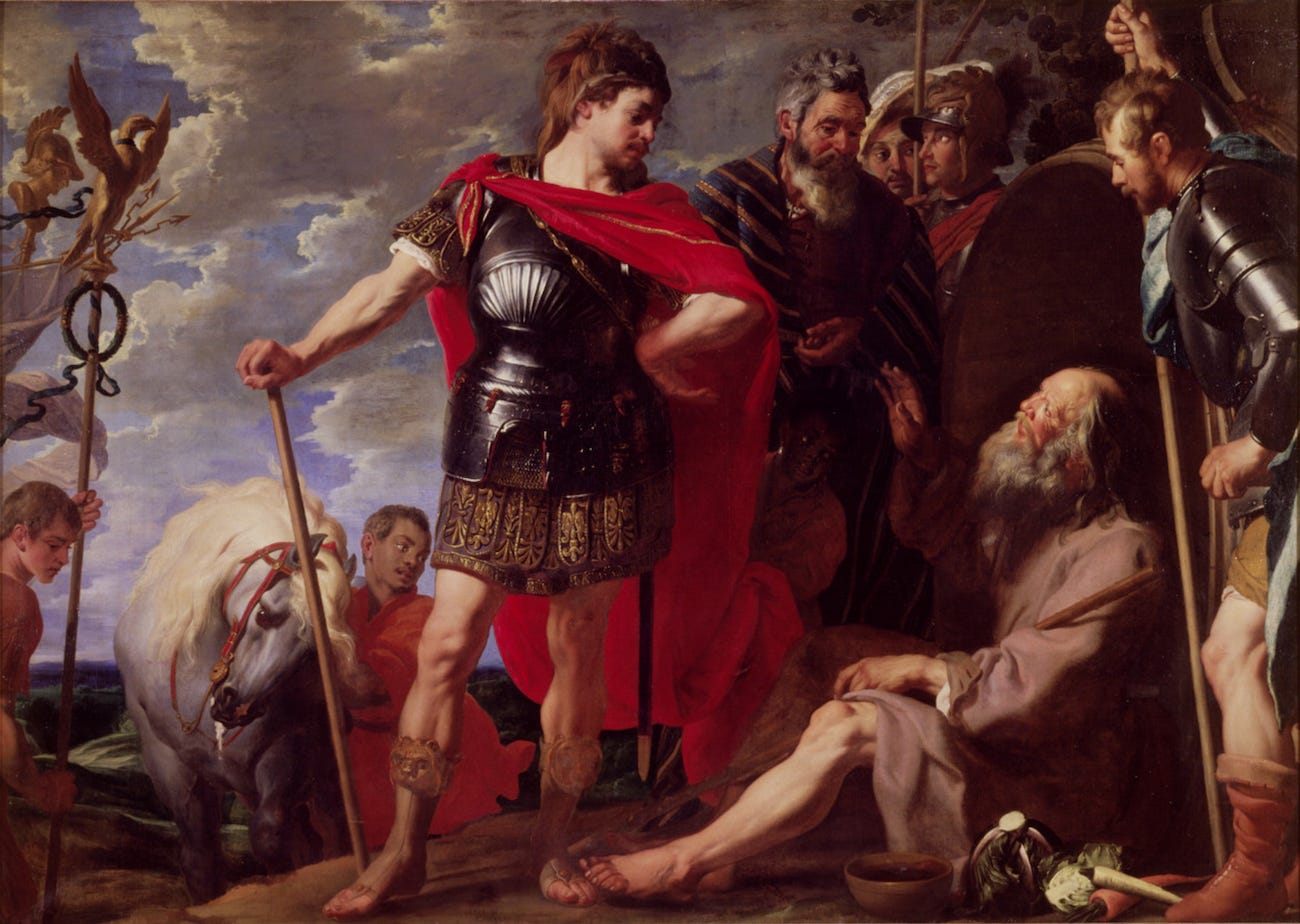
Alexander and Diogenes by Caspar de Crayer (c. 1650), Wikipedia

Diogenes was asked by Alexander’s father, King Phillip II, if he was a spy, to which the philosopher replied, “I most certainly am a spy, Philip. I spy on your absence of wisdom and common sense, which is the only thing forcing you to go and gamble your kingdom and your life in a single moment.”
Such a retort earned him a “vacation” in a Greek prison.
Accounts differ, but years later, during Diogenes’ encounter with Alexander, it is believed that the philosopher was sleeping when Alexander approached him and asked Diogenes what he could do for him. Diogenes’ response, “Stand aside to stop blocking the sun.”
To insult the great conqueror could have resulted in his capture again or even his death, but Alexander was not displeased. Instead, he said, “If I were not Alexander, I would want to be Diogenes.”
“If I were not Diogenes, I would also wish to be Diogenes,” he responded.
It’s easy to simply categorize Diogenes as a negative individual with a pessimistic philosophy to boot, but that would be ignoring the larger picture of his teachings. Although Diogenes was often dismissed as absurd, his audacity earned the respect of his fellow philosophers, including Alexander the Great.
Diogenes’ life was a reminder that freedom isn’t found in comfort or conformity, but in the courage to live without either.
His defiance made him a fool to some and a genius to others, but his point was never lost: freedom disappears the moment we mistake performance for living.